Saturday, April 13, 2013

The Gosnell Matter

It's taken a long time for the mainstream media to come around to the reality of it, but it seems like the trial of Kermit Gosnell, who ran an abbatoir in Philadelphia that was thinly disguised as an abortion clinic, does merit a little attention, even though the narrative is well, a little problematic. Megan McArdle, donning her hairshirt, explains why:
So I'll tell you why I haven't covered it.

To start, it makes me ill. I haven't been able to bring myself to read the grand jury inquiry. I am someone who cringes when I hear a description of a sprained ankle.
 
But I understand why my readers suspect me, and other pro-choice mainstream journalists, of being selective—of not wanting to cover the story because it showcased the ugliest possibilities of abortion rights. The truth is that most of us tend to be less interested in sick-making stories—if the sick-making was done by "our side."

Of course, I'm not saying that I identify with criminal abortionists who kill infants and grievously wound their patients. But I am pro-choice.

What Gosnell did was not some inevitable result of legal abortion. But while legal abortion was not sufficient to create the horrors in Philadelphia, it was necessary. Gosnell was able to harm so many women and babies because he operated in the open.
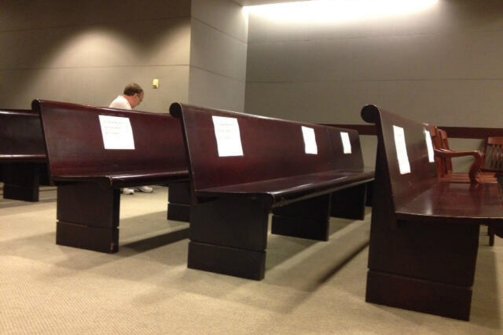
Indeed. As has been documented, Gosnell's operation wasn't inspected for 17 years. And that's just part of the story. Increasingly, the story is that there really hasn't been a story. Or at least much reporting of the story. McArdle shares a damning photo of the press gallery at Gosnell's trial:

The presence of absence
Why the press blackout? There are excuses about, including this one, as related by Mollie Hemingway:
Then I decided, since tmatt has me reading the Washington Post every day, to look at how the paper’s health policy reporter was covering Gosnell. I have critiqued many of her stories on the Susan G. Komen Foundation (she wrote quite a bit about that) and the Sandra Fluke controversy (she wrote quite a bit about that) and the Todd Akin controversy (you know where this is going). In fact, a site search for that reporter — who is named Sarah Kliff — and stories Akin and Fluke and Komen — yields more than 80 hits. Guess how many stories she’s done on this abortionist’s mass murder trial.

Did you guess zero? You’d be right.

So I asked her about it. Here’s her response:
Hi Molly – I cover policy for the Washington Post, not local crime, hence why I wrote about all the policy issues you mention.
Local crime. Can't be bothered. Not even's Kliff's Notes. So did Sarah Kliff write about the murder of George Tiller, the Kansas abortionist who ran a clinic that performed the same sorts of services that Gosnell provided, although with better hygiene standards? Why yes, yes she did.

When an abortionist is murdered, it's a national story. When an abortionist kills babies who are inadvertently born by snapping their spinal cords with a scissors? Local crime. Good to know.

For her part, McArdle recognizes the moral blind alley:
I could defend myself by saying that I wasn't aware that the Gosnell trial was going on. Abortion is not my beat, and the mailing lists that I am on weren't exactly blasting the news of this trial.
 
But that doesn't totally let me off the hook. I knew about the Gosnell case, and I wish I had followed it more closely, even though I'd rather not. In fact, those of us who are pro-choice should be especially interested. The whole point of legal abortion is to prevent what happened in Philadelphia: to make it safer and more humane. Somehow that ideal went terribly, horribly awry. We should demand to know why.
True. By now, an alert reader might also ask -- hey Mr. D, you haven't been writing about Gosnell much either? What gives? Are you part of the Media Industrial Complex, too?

And like McArdle, I have no excuse. It's easier to snark on the Vikings than it is to confront something as truly horrific as what Kermit Gosnell did. I have to do better as well. From what we've been able to learn about Kermit Gosnell, he appears to be a monster comparable to Manson, or Dahmer, or Gacy. Yet if you were to ask most people who he is, you'd get a blank stare. Any why is that? Back to McArdle:
Moreover, surely those of us who are pro-choice must worry that this will restrict access to abortion: that a crackdown on abortion clinics will follow, with onerous white-glove inspections; that a revolted public will demand more restrictions on late-term abortions; or that women will be too afraid of Gosnell-style crimes to seek a medically necessary abortion.
A revolted public is dangerous to many things that certain people hold dear. As Justice Brandeis famously observed:
"Publicity is justly commended as a remedy for social and industrial diseases. Sunlight is said to be the best of disinfectants; electric light the most efficient policeman."
Time for all of us to turn on the lights.

Friday, April 12, 2013

Change!

I try to keep things in perspective:


And what would be worse than having an odious scold like Michael Bloomberg as mayor of New York? Oh, let's see:

America's Finest Newspaper Strikes Again

Declare the pennies on your eyes

They gotta have more money at the lege:
Taxes on clothing, over-the-counter drugs, and even dance lessons and tattoos could be back in play at the Capitol as Minnesota Senate DFLers continue to look for ways to raise revenue and reform the state’s tax system.

The Senate plan, released Thursday, resurrects pieces of a controversial tax proposal abandoned earlier this year by Gov. Mark Dayton. It would broaden the sales tax but also lower the overall rate to its lowest level in decades. Corporate income taxes would be trimmed, and the plan includes a yearly rebate for lower-income Minnesotans hit hardest by a clothing tax. Similar to a proposal in the House, the Senate package has a sports memorabilia tax to help pay the state’s share of the new Minnesota Vikings stadium.
Why now? Well, some legislators just can't give it a (ahem) rest, so to speak:
“We think his [Dayton’s] policies and principles were absolutely in the right direction. They were bold and thoroughly vetted,” said Sen. Ann Rest, a New Hope DFLer who is chairwoman of the Senate Tax Reform Division. “We hope to convince him this is the right time for reform and that Senate Democrats will stand firm with him in going that direction.”
As usual, the proposal includes the sort of "we'll throw you a bone" approach that pretends to help people, but really doesn't:
Unlike Dayton’s proposal, the Senate plan would tax all clothing purchases, not just those over $100. To ease the pain, the state would spend $66.9 million on the income tax credit for lower-income families. A family of four making $44,000 a year would get about $60 a year. The credit would shrink as family income rose.

To make up for the lost revenue, those who buy online goods, custom software, and box seats and suites at pro sporting events would have to pay sales tax. Clothing consumers would pay an additional $541 million in sales taxes over the next two years.
Do ya think that $60 will help a family much? Suppose you buy the kids four new outfits apiece for school and the total cost of this outlay is $500, which isn't an unreasonable expectation. If you figure the tax at about 6%, and it will most certainly be more in the metro, that would be $30. Now if Mom and dad buy anything for themselves, the other half of the $60 is gone. And since most people in the metro make more than $44,000 a year, this is going to be a good sized hit to most family budgets. And if you're a young single hipster on the make, Rest would like a word with you, too:
Other new tax targets: tattoos, dating services and personal lessons, such as those for dancing, golf or tennis.
When it comes to taxes, all Minnesotans can expect a personal lesson.

Thursday, April 11, 2013

Meanwhile, back at the Vaseline Dome

The electronic pulltabs that were supposed to finance the new Vikings stadium aren't pulling anything, so now it's time for the dreaded foam finger frenzy:
Legislators are beginning a hard-nosed search for alternatives to electronic gambling to help pay for the planned Minnesota Vikings stadium, even as team officials met with state officials Wednesday to strategize about how to get more people playing the new barroom games.

They are being spurred by the feeble rollout of new electronic pulltabs games, which were to cover the state’s share of the $975 million stadium in downtown Minneapolis. Gov. Mark Dayton’s aides met with Vikings officials in private on the topic while in public, House Taxes Committee Chairwoman Ann Lenczewski, DFL-Bloomington, promoted a once-discarded idea: Taxing pro jerseys and foam-finger sports memorabilia.
Of course, foam fingers won't get you there, either:
Lenczewski formally revived an idea that was originally included in the 2012 Vikings stadium bill but was dropped along the way. She would apply a 10 percent tax on wholesale sales of professional sports memorabilia, no matter where it is sold — whether at a pro stadium or at Target. The tax would also be levied on rentals of stadium boxes and suites. It is projected to bring in more than $12 million per year — a little more than a third of what the state needs.
If we've learned anything throughout this process, it's this: projections don't mean much. So that $12 million that Lenczewski wants isn't going to pan out, either.

For their part, the Vikings are saying what we've suspected they would say all along, to wit: Not our problem. A deal is a deal.
“We’re opposed because this legislation fundamentally changes the agreement the Vikings negotiated with the state of Minnesota,” Vikings Vice President Lester Bagley said. He described the team’s contribution of $477 million as considerable and said the Vikings do not believe they should pay more.
The Vikings, like everyone else in the NFL, subscribe to a version of what used to be called the Brezhnev Doctrine: what we have, we keep. And what they have is the legislature by the short hairs.

Paging Dr. Grubman

After the Mayo Clinic's majordomo mentioned that there were 49 other states that might want to have the Mayo Clinic, the matter of the money for Rochester came before the lege yesterday. Let's just say it didn't go well:

The “49 states” line was a sore point for committee members, who were seething over a comment Mayo President and CEO Dr. John Noseworthy made to the Star Tribune Tuesday while speaking in Washington. If the Legislature didn’t pass the bill, Noseworthy warned, “49 states” are eager to help the Mayo Clinic relocate.

“It was a dumb thing to say. It was dumb, dumb, dumb,” said state Rep. John Lesch, DFL-St. Paul, adding that Noseworthy’s remark made him less inclined to vote for the bill. “Your CEO [was] going to the National Press Club in Washington, D.C., and wagging a finger at the Minnesota Legislature. That’s what it looked like to me … I was thoroughly disgusted.”
Yep -- finger-wagging is the legislature's job. The Mayo needs to get its mind right. Alternatively, they could use a better threatmaker. About this time last year we were getting the alarums from the button man for the National Football League, Eric Grubman, concerning the Vikings stadium. Good times, good times:

"In the 20 years that I've watched teams change hands, a lot of things get talked about. But until things are really ripe, nothing happens. This is getting ripe," NFL executive vice president of business operations Eric Grubman told the Minneapolis Star Tribune. "You have a very dejected ownership. They've run out of options. They feel like they've done everything they've been asked to do and they can't get a vote. No one will answer the question, 'What is it going to take?'"

"The Vikings have said, 'Give us A, B and C, what would you like us to do?' They've been told A, B and C, and they've done that. And they still can't get through. So what makes anyone think it's going to be any better or different next year or the year after?"
Now see, that's how you make a threat.

Wednesday, April 10, 2013

Avenue of the Saints

Blizzard in the rearview
We’ve left where Frank and Jesse met their Match
Eddies and swales cross our path
A 2 inch tarantella of ice and caprice
Charles City, fifteen miles ahead
Plaything of the wind1

Sorting, sifting
A well-traveled path to destinations you’d
Not thought to seek
New experiences in old towns
History recorded on brown highway signs

We’re bound for Galesburg, where Lincoln and Douglas
Talked shop in ’58, a windswept prairie town
Where a prairie poet learned to cry over beautiful things,
Knowing no beautiful thing lasts2

Four hours ahead, Iowa 80 splatters neon to
The heavens, beckoning Peterbilts with
Hot showers and cold comfort
Past Herbert Hoover’s boyhood home

Whole damn thing seems like Hooverville

The boy’s dreams find focus
Tweaked in Buntrock Commons3, now borne
Downwind from Rock Island

The journey begins tomorrow
Three miles south of the Carl Sandburg Mall

 
1Cf. Carl Sandburg; in 1968, a tornado destroyed most of Charles City, Iowa, killing 13 people
2Sandburg, “Autumn Movement”
3The student center of St. Olaf College

Ask for them by name


Zygi Mayo

Hey, it worked for Zygi Wilf:
In blunt words aimed squarely at the Minnesota Legislature, the president and CEO of the Mayo Clinic warned Tuesday that the hallowed medical institution has “49 states” eager to have Mayo’s planned multibillion-dollar expansion if the state is unwilling to pitch in.

“We’re never going to leave Minnesota, and we don’t want to leave Minnesota,” Dr. John Noseworthy said in an interview at the National Press Club, where the CEO made a pitch for federal investment in health care and medical research. “But we’ve got to decide where we’re going to put the next $3 billion.”

That money would be part of a $5 billion, 20-year expansion in Rochester dubbed “Destination Medical Center,” which would require a half-billion dollars from state officials for infrastructure improvements.

“If they say yes, that’s great, we want to stay in Minnesota,” Noseworthy said. But, he cautioned, “If they say no, or you’re going to have to go for a bonding bill every year for the next 30 years, we’ll have to rethink about whether that’s the best use of our money.”
(Must. Avoid. Lame. Joke. About. Name. Noseworthy. Too. Easy.)

Maybe the good doctor knows of places that have an extra $500 million lying around, but a little skepticism is in order here. We'll know they're serious when you see dudes wearing lab coats and Helga Braids showing up in Mark Dayton's breakfast nook.

Brother Obama's Traveling Salvation Show

One of the most irritating things about Barack Obama is that he is perfectly willing to excoriate his political opponents for using the same tactics he favors. You may have noticed that he's been traveling across the country this week, using his big plane and his big megaphone, to campaign for gun control. At one stop he said the following:
President Obama criticized the proposed filibuster during a campaign-style event at the University of Hartford in Connecticut about 45 miles from the elementary school where 20 first-graders were shot and killed in December.

“Some back in Washington are already floating the idea that they might use political stunts,” said Obama, who was introduced by Nicole Hockley, whose son, Dylan, was one of the victims. “They’re not just saying they’ll vote ‘no’ on ideas that almost all Americans support. They’re saying they won’t allow any votes on them at all.”

Many in the crowd responded by chanting: “We want a vote.”
So, apparently flying around the country and conducting political rallies of this sort isn't a stunt. The ever-perceptive John Hayward offers the proper response:
How dare these Republicans attempt a political stunt! Don’t they know only Obama is allowed to stage those? Obama’s little dramatic productions come at substantial taxpayer expense, since not only have the President and his immense retinue been flying around the country to hold campaign rallies, but he’s flying eleven family members of the Sandy Hook Elementary School victims back to Washington aboard Air Force One so they can lobby for new gun control laws. With all due respect to these grieving parents, how can that avoid classification as a “stunt?” Shouldn’t this legislation face sober deliberation, and stand on its own legal and logical merits?


Of course not. If sober deliberation is used, the legislation fails, so ginning up emotion is the ticket. It's not surprising, though -- as we've noted countless times before, Obama's genius lies in the stagecraft of the political campaign and not in the give-and-take of negotiations, especially in Washington. All this has been amply documented, of course, and we've seen it repeatedly this year as we lurch from one crisis to the next.

Every president has a bully pulpit and they all use it with varying degrees of success, but at some point a president needs to move beyond this sort of thing. I don't see any evidence that Obama is capable of that.

Tuesday, April 09, 2013

Mrs. Thatcher

I don't know that I have much to add about the legacy of Margaret Thatcher, who died yesterday. Although I should say this much:

A relative of mine posted the following on Facebook, noting the passing of Annette Funicello, who also left this world yesterday:

Who made the world a happier place? Margaret Thatcher or Annette Funicello?

Let’s see. One was an actress who starred in a series of enjoyable, light-hearted movies that captured the spirit of the beach culture of California, following a successful run in an ensemble television show of the 1950s. The other was a world-historical figure who was arguably the most powerful woman in history, whose famous resolve, strategic thinking and consistent statecraft during a dozen-year run as Prime Minister of one of the world’s great nations was instrumental in helping to topple a tyranny that spread across half a continent.

That’s a tough one. Maybe you could ask a Czech. Meanwhile, here's another perspective. Read it before you scoff.


Monday, April 08, 2013

Commuting the Sentence

Walter Russell Mead on commuting:
Some jobs need to be done face to face, and many jobs require at least some direct interaction among people who are physically together. But the average American commutes 25.4 minutes each way to work. The information revolution is reducing the need for commuting; fewer and fewer jobs now require that everyone drive to the same room, and as a society we are getting better at working cooperatively over distances. Whether you are a feminist, an environmentalist, an economist, a pro-family activist or just a person who wants to live a little better than you do, telework is a cause that you need to embrace.

One of these days one or both parties is going to realize that killing the commute is the kind of social change that Americans want their leaders to push. Until that happy day, we recommend deep breathing (but not near commuting thoroughfares) and music or podcasts that put you at ease. Stress kills, and death by commuting is a terrible way to go.
Emphasis is original. In this instance, I'm above average, since my commute typically is 40-45 minutes on a good day and can be much worse if I encounter weather or a wreck on the highway. I write for a living and most of my colleagues could do their jobs just fine from home, instead of heading to the cube farm that is our suburban office.

In our office, the corporate culture tends to work against telecommuting, because we tend to have a "drop in unannounced" style. People come into my office all day long to visit, ask a question or dump work on my desk, but only rarely do I get a phone call; there are days when my phone never rings. Some folks would call such an approach "collaborative," while others would call it rude. My team features a bunch of introverts, which makes the culture problematic at times, but there's a logic behind it; you can let a phone go to voice mail, but it's tough to ignore a person standing in your doorway.

So let's throw the question out for discussion. First, can you telecommute? Or if you don't, do you think your job could be done remotely?

Saturday, April 06, 2013

The Inevitable Grampa Sports Walkback

I've lived in the Twin Cities for over 20 years now and if there's any constant in the media world around here, it's this eternal pattern:
  • A coach is fired
  • Sid Hartman hates it and provide much hagiography upon said coach's departure*
  • The new coach is introduced
  • Sid is hostile to the new coach at the press conference, or to the athletic director/general manager who hired the new coach, or both
  • The subsequent column begins the process of hagiography for the new coach
We saw this again when Tubby Smith got ashcanned and new Gophers basketball coach Richard Pitino was introduced. Sid's Friday column was hostile, especially where Gopher AD Norwood Teague was concerned:
That’s why it made a lot of sense to hire Flip Saunders, with his experience as a coach in college and the NBA, but it was pretty evident that even though he was offered the job, he turned it down because he couldn’t operate under Gophers athletic director Norwood Teague’s terms.

Well, it turned out before and after the Saunders negotiations that it was difficult to hire a coach. Teague didn’t contact incoming coach Richard Pitino until Monday and hired him two days later, after Teague was turned down by a number of other candidates. And Teague didn’t contact Eric Musselman until a few days ago, and the son of former Gophers and Wolves coach Bill Musselman was available if Teague hadn’t decided to hire Pitino.
Today, after Sid took a few shots at Teague at the press conference, he's begun the lionization of young Pitino:
I’ve attended many news conferences at the University of Minnesota concerning new head coaches in major sports, and I don’t believe anyone made a better impression than Pitino did when introduced as the successor to Tubby Smith.
Heh. Guess I can't blame Sid. This shtick has worked since he attended the press conference introducing Bronko Nagurski. Why stop now?

*This does not apply to women's coaches for any team, who don't actually exist in el Mundo Sid.

Roger Ebert, RIP

Meant to get to this yesterday, but Roger Ebert has died. He was probably the most influential film critic in history and he was a hell of a writer. Didn't care much for his politics, but for the most part I thought his reviews were pretty much spot-on.

Ebert's "Glossary of Movie Terms" is a particular favorite, because nearly all the observations Ebert makes ring true and most are hilarious. A few examples:

Fallacy of the Talking Killer: The villain wants to kill the hero. He has him cornered at gunpoint. All he has to do is pull the trigger. But he always talks first. He explains the hero's mistakes to him. Jeers. Laughs.And gives the hero time to think his way out of the situation, or be rescued by his buddy. Cf. most JAMES BOND movies.

Bullitt Shift: Cars in high-speed chases can shift through more gears than they have. Cf. Steve McQueen's car upshifts more than 16 times.

Rising Sidewalk: No female character in an action film can flee more than 50 feet before falling flat on her face. Someone then has to go back and help her up, while the monster/villain/enemy gains ground.

Fallacy of the Predictable Tree: The logical error committed every time the good guy is able to predict exactly what the bad guy is going to do. For example, in FIRST BLOOD, law enforcement officials are searching the woods for John Rambo. A cop pauses under a tree. Rambo drops on him. Question: Out of all the trees in the forest, how did Rambo know which one the guy would pause under?
There are a lot more at the link. RIP.

Friday, April 05, 2013

Too late, baby

So, are we going to scuttle the Viking ship?
Minnesota should put plans for a new Vikings stadium on hold until it can figure out a better way to pay for it, some state lawmakers say.

Electronic pulltabs were supposed to fund the state's $384 million share of the new football stadium. But in their first year, e-pulltabs pulled in a dismal $1.7 million -- well below the $35 million a year needed -- forcing the state to scramble for alternative revenue sources, like electronic bingo games.

Instead of scrambling, state Sen. Sean Nienow says, Minnesota should slow down, put the entire stadium venture on hold, and figure out a secure way of paying for a new home for the Vikings.
I agree, but it's too late for that now. The agreement's been made and if the state tries to change the terms now, we'll be looking at multiple lawsuits that will only add to the overall bill.

The bill that Nienow and Rep. Mary Franson are proposing would delay the bond sale until the state figures out its financing. There's no chance that the bill will ever see the light of day, but I suspect that's not the point as much as it is to again shine a light on the performance of Gov. Dayton and the others who were responsible for this deal. While that's always a useful exercise, there's no reason to get our hopes up.

Thursday, April 04, 2013

Son of a Preacher Man

So the Gophers finally hired a basketball coach, after supposedly being turned down by Shaka Smart, Brad Stevens, Fred Hoiberg, Flip Saunders, Mick Cronin, Andy Enfield and the cute girl in the chemistry lab. Their new coach is going to be Richard Pitino, son of coaching legend Rick Pitino:
Pitino, 30, was an assistant coach at Northeastern, Duquesne, Florida and Louisville — working as the top assistant under his father during the 2011-12 season. He accepted the position at Florida International last year, where he had signed a five-year contract with a base salary of $250,000 a year. Pitino’s buyout at FIU reportedly is also $250,000. Terms of the Minnesota deal are not yet known, but he can expect a significant raise. A news conference to introduce Pitino likely will be Friday.

Pitino, who led Florida International this season in his first year of head coaching, is less than half the age of Smith and the youngest of any Minnesota basketball coach since the Gophers’ original coach in 1897.
This hire actually may turn out well. It speaks well of young Pitino that he was willing to work for people other than his famous father. Among his other mentors is Billy Donovan, the highly successful coach at Florida who was in turn a protege of Pitino's father. Relationships in the coaching business often work this way and the younger Pitino seems to have made the right moves up to this point.

The goofy thing about this coaching search has been that neither Norwood Teague, the Gopher athletic director, nor his top assistant Mike Ellis, has said much of anything during the search period, which allowed speculation to run rampant. We don't really know if the Gophers actually made a job offer to any of the individuals that were linked to the job, although it's reasonable to surmise that most of the candidates would have been plausible.

The other thing that was likely painful for Gopher fans to learn is that the job isn't necessarily well regarded. While the Gophers are members in good standing of the Big Ten, they haven't been especially relevant in the conference for a very long time now. Over a dozen seasons have passed since Clem Haskins was run out of town and in the years since then, the Gophers haven't finished any higher than the middle of the pack in the Big Ten and mostly have been residing in the second division. It's a tough neighborhood, of course, but aside from perennial dogs Northwestern and Penn State and newcomer Nebraska, no team has been less successful than the Gophers in recent years. The national press did a lot of sneering at the news that Tubby Smith had been fired and it couldn't have been much fun to learn that at least some coaches apparently preferred life in the mid-majors to walking the ancient floors of Williams Arena.

It's easy to see why, though -- as much as people around here love the Barn, it's an old building and it has to be a tough sell to recruits who can see much more modern facilities elsewhere. And given the sense of entitlement that many young basketball players learn from their AAU experiences, the idea of playing in an antiquated facility can't be particularly appealing.

Can Richard Pitino change that dynamic? Perhaps, although it was telling that on KARE's 10 p.m broadcast last night, sports anchor Eric Perkins was openly speculating that young Pitino would be using this job as a stepping stone and wondered aloud how long he'd stay here. There's a lot of fatalism in the Minnesota fan base.

Wednesday, April 03, 2013

Shocka!

I can't hardly believe it myself:
The ensuing judgment over the less-than-expected gambling revenue needed to fund the state's share of a new NFL stadium is premature and politically motivated, Gov. Mark Dayton said.  
You mean something happening in the State Capitol is politically motivated? Gasp, anything but that!
"What is there to investigate? I mean there were honest assumptions made," Dayton said. "If somebody thinks there was wrongdoing then they should definitely produce the evidence that would support that. Otherwise, it's slow getting off to a start. Everybody agree with that. We missed the projections. Everybody agrees with that. We're working to correct it."
 This might be news to the governor, but investigations are a time-tested way to determine if wrongdoing has occurred. Personally, I don't suspect "wrongdoing." But there's ample reason to suspect a lack of due diligence and a boatload of wishful thinking.

Pro tip, Mr. Dayton:  if you don't want to be held accountable for things you do, it's a good idea to avoid doing things like running for governor.

Oh, great

Something wicked this way comes:
Emboldened by its meteoric rise in Greece, the far-right Golden Dawn party is spreading its tentacles abroad, amid fears it is acting on its pledge to "create cells in every corner of the world". The extremist group, which forged links with British neo-Nazis when it was founded in the 1980s, has begun opening offices in Germany, Australia, Canada and the US.

The international push follows successive polls that show Golden Dawn entrenching its position as Greece's third, and fastest growing, political force. First catapulted into parliament with 18 MPs last year, the ultra-nationalists captured 11.5% support in a recent survey conducted by polling company Public Issue.

The group – whose logo resembles the swastika and whose members are prone to give Nazi salutes – has gone from strength to strength, promoting itself as the only force willing to take on the "rotten establishment". Amid rumours of backing from wealthy shipowners, it has succeeded in opening party offices across Greece.
Bad ideas never really die, of course. And when times are tough, you'll get a Golden Dawn, or a Shining Path, or some other group. Frankly, the left/right distinction doesn't really mean that much. What does matter is that people who ought to know better (such as wealthy shipowners) think they can ride the tiger.

It won't end well.

Tuesday, April 02, 2013

No Joy in Mudville

It has been reputed that the town baseball team in Stockton, California was the inspiration for the famous poem "Casey at the Bat," because they have long played baseball games on Banner Island, a place known as  Mudville. Some 125 years after Ernest Thayer wrote his poem, mighty Stockton has struck out:

Stockton, California, the biggest U.S. city to file for bankruptcy, won a judge’s permission to stay under court protection after he found that creditors didn’t negotiate in good faith with the city.

Creditors, including Assured Guaranty Corp. and Franklin Resources Inc. (BEN), argued that Stockton didn’t qualify for bankruptcy because its leaders didn’t negotiate a potential settlement in good faith and the city isn’t truly insolvent.

Why is Stockton, a city of nearly 300,000 people located about 80 miles east of San Francisco, in bankruptcy? Well, pretty much for the same reason that many individuals end up in bankruptcy:
Stockton joined cities across the country using the U.S. Bankruptcy Code to get out from under billions of dollars in obligations they couldn’t afford following the longest recession since the 1930s. Stockton rode a surge in new-home construction in the 2000s that preceded the housing crash and then a wave of foreclosures that sapped the city’s tax-revenue gains.
And there were other reasons:
The city is slated to stop paying for retiree health care on June 30 as part of a spending plan the City Council approved in June, citing a $417 million unfunded liability. The benefit had allowed workers employed as little as a month to receive city-paid health coverage for life for employees and spouses, City Manager Bob Deis said.
Emphasis mine. Think about that. Work a month, be set for life. Wonder why that didn't work out so well. But there was more, of course:
Born in the Gold Rush, Stockton struggled for decades, relying on tax revenue from farming and shipping at its deep- water port on the San Joaquin River. A housing boom in the early 2000s brought a surge in revenue as homebuyers, seeking refuge from soaring prices in San Francisco and Silicon Valley, flocked to Stockton, where starter homes cost around $400,000.

The city used the increase and issued debt to build a gleaming new arena and ballpark on its riverfront and to buy a new City Hall it later couldn’t afford to occupy.

Wow, money for ballparks and arenas? Thank goodness we'd never do anything like that here in the Twin Cities, but I digress. So what happened?
The Stockton metropolitan area last year had the highest foreclosure rate in the U.S., affecting one in every 25 homes, or almost three times the national average, according to RealtyTrac Inc., an Irvine, California-based data provider.

And what else happened to all those folks who bought the $400K starter homes?

About 14 of every 1,000 residents in Stockton were victims of violent crime in 2011, a year in which the city was yet again the second most violent city in California.

In crimes per capita, only Oakland outpaces Stockton.
And where does Stockton stand in the bigger picture?
Nationwide, Stockton was the 10th most violent city on a list topped by Flint, Mich. Detroit, St. Louis, Oakland and Memphis, Tenn., rounded out the top five.

Meanwhile, other California cities have been queued up for the same thing. San Bernardino filed for bankruptcy last year:

The city, located 65 miles east of Los Angeles, could become the third municipality in California to seek protection from its creditors since late June. Stockton and the ski resort city of Mammoth Lakes have already filed in bankruptcy court.

A fourth city, Compton on the outskirts of Los Angeles, could be the next city to turn to bankruptcy protection. 

And there will be more.

Monday, April 01, 2013

Opening Day in the Upper Midwest

They have a retractable roof in Milwaukee, so people were a little more comfortable as the Brewers beat the Colorado Rockies 5-4 in 10 innings. Brewers catcher Jonathan Lucroy drove in the winning run with a sacrifice fly in the 10th inning:

Associated Press
Meanwhile, the fans at Target Field were dressed for winter, since it still felt like it on a pretty but cold April afternoon, as the Twins fell to the Detroit Tigers, 4-2:

Jerry Holt, Star Tribune
Yeah, it's cold out there. But it's baseball season. About time.

Opening Day

Baseball season is here. I can see it over the snowbanks. The Twins will host the defending AL Champion Detroit Tigers today at Target Field, while my beloved Milwaukee Brewers will lift the lid against the Colorado Rockies at Miller Park.

I'm not sure what we're going to see from either team this year, which ordinarily isn't a good sign. The Twins are probably 2-3 years away from being a contender, especially given that they are sending out Vance Worley as their opening day starter. There are some big arms in the Twins system, but they are a few years away from contributing, apparently. Worley is a righthander with marginal stuff that the Twins picked up from the Phillies in the Ben Revere trade and he's had a pretty rough spring. He's got a chance to win about 10-12 games this year, but he's not the sort of guy who is going to make you forget Johan Santana. I don't mean to pick on Worley, who is good enough to pitch in the major leagues, but he's not a number one starter. On a good staff, Worley would be, at best, a number three or four. The Twins do not have a good staff. Once this guy and this guy get there, it will be different, but that won't be until later, perhaps much later.

Meanwhile, the Tigers come to town with Justin Verlander, the best starter in the American League, on the mound. It's going to be cold out there today; it's possible the temperature will not get above freezing in the Twin Cities. I'll bet it will be a lot of fun for the Twins to try to hit Verlander, who can throw it about 98-99 miles per hour when he thinks it appropriate.

The Brewers will be sending their ace, Yovani Gallardo, out to face a guy I've never heard of, Jhoulys Chacin, for the Rockies. The Brewers played very well down the stretch last year but there are a lot of questions about their pitching beyond Gallardo, who should win at least 15 games this season. The Rockies appear to be a train wreck, so this isn't a bad way to begin the season. The Brew Crew should be much like they've been in recent years -- a very good team offensively, with dicey pitching. The key could be whether the gendarmes go after Ryan Braun for his (ahem) business relationship with Biogenesis, the Miami-based clinic that might have been providing performance enhancing drugs to major leaguers. Braun beat a drug test last year and I suspect that he'll be getting a whole lot of scrutiny for the rest of his career. If Braun continues to anchor their lineup, the Brew Crew will be dangerous. If he gets a suspension, they'll be toast.

This is the time to have hope, of course, but I don't see either the Brew Crew or the Twins being very good this year. If I were to guess, I'd pencil the Brewers in for a 3rd place finish in the NL Central (behind Cincinnati and St. Louis) and the Twins to bring up the rear in the AL Central, although Cleveland doesn't look like they're going to be much, either.

If I were to guess, I'd figure that the World Series will be Detroit vs. Washington. Which means both teams are likely doomed. Make your picks in the comment section.