Tuesday, April 06, 2010

A little help, here

If ever a column deserved a good and thorough fisking, it's this one from Robert Samuelson in the Washington Post. A taste of its rich, meaty wrong-headedness:

But in truth, differences between parties are often small. Democrats want to spend more and don't want to raise taxes, except on higher earners. Republicans want to reduce taxes but don't want to spend less.

Dude never met John Marty -- that much is certain. In any event, there's more, a lot more, in this primo bit of thumb sucking. Problem is, I don't have time this morning to give this the attention it deserves. So why not have a little fun with it? Your assignment, should you choose to accept it: click on the link, find a risible statement and give that ol' pinata a whack in the comments section. I'm betting you can find a bunch of them if you look really hard.

Group fisking: an idea whose time has come.

Monday, April 05, 2010

News You Could Have Used Redux


Oh, we're learning a lot these days. Here's Alan Greenspan, talking to Jake Tapper (H/T: Captain Ed) about Congressional Budget Office scoring of Obamacare:


TAPPER: The president signed massive health care reform legislation into law a few weeks ago. You have expressed concern about the legislation, as it was making its way through the process, about whether or not it did enough to contain costs. What did you think about the final legislation? Does it contain costs enough?
GREENSPAN: Well, the CBO, incidentally, Congressional Budget Office, which is really a first-rate operation, says that it does. The problem is not their estimates, but the range of potential error in those estimates.

"Range of potential error," you say? Tell us more, Mr. Greenspan:


And when you're dealing with an economy in which debt is becoming -- federal debt is becoming ever increasingly a problem, it strikes me that when you're dealing with public policy and you're in a position where you have to ask yourself, "What happens if we are wrong?"
Our solons are not very good at imagining that they are wrong, but let's go with it. Tell us more, former acolyte of Ayn Rand:


In other words, in the case now, where our buffer between our capacity to borrow and our actual debt is narrowing, for the first time, I think, in the American history, there's a question, supposing we are wrong on the cost estimates, and, indeed, they are actually much higher than the best estimates can generate, the consequences are very severe, whereas if they are too high, it's very easy to adjust.

The consequences are very severe? Really? Who knew? (Don't all raise your hands at once, audience. But I digress.) But what is the likelihood of that, Mr. Greenspan?


So I think it's -- it's -- there's an issue over and above the question of what's the best cost estimate. There's a policy strategy here which I think requires us to lean in an ever more conservative area with respect to judging...

Hmmm. So what does that mean? Tapper asks the question and gets a response that ought to leave us all a little queasy.


TAPPER: So it might have been too rosy, the projections, you're saying?

GREENSPAN: Possibly. I don't know that. But I do know that the probability that it might be is much higher than we would like.

Let me translate that for you. Greenspan really means, yes the projections were baked wind. But we knew that, didn't we? So that shouldn't be surprising.

Here's something else that might not surprise this audience, but should really shake up the rubes. Byron York has been doing a little digging on the matter. Take it away, Max Baucus:


In his halting, jumbled style, Baucus explained that in recent years, "the maldistribution of income in America has gone up way too much, the wealthy are getting way, way too wealthy, and the middle-income class is left behind." The new healthcare legislation, Baucus promised, "will have the effect of addressing that maldistribution of income in America."

Some who heard Baucus's speech though his style was halting and jumbled because he'd had a few highballs before addressing the body. In vino veritas and all. But don't you wonder how Max knows these things? Turns out he's not the only one who has a different view of what ObamaCare is designed to do. Howard Dean, M.D., has offered his diagnosis:


At about the same time, Howard Dean, the former Democratic National Committee chairman and presidential candidate, said the health bill was needed to correct economic inequities. "The question is, in a democracy, what is the right balance between those at the top ... and those at the bottom?" Dean said during an appearance on CNBC. "When it gets out of whack, as it did in the 1920s, and it has now, you need to do some redistribution. This is a form of redistribution."

You need to do some redistribution, huh? Well, I guess that's right. Every swindler I've ever heard of has been quite keen to redistribute wealth. I posted that picture of Howard Dean because it looks like he's landing a punch. If you feel like your jaw hurts, now you know why. And if you want a little music to go with this post, here you go.

Henry Waxman's Knowledge Problem

I recently wrote about Henry Waxman's evident dismay that companies would deign to explain the downside of Obamacare so soon. Glenn Reynolds, the U. of Tennessee law professor who runs Instapundit, picks up the same ball, runs with it, and notices that the ball has the signature of Hayek:

In his "The Use of Knowledge In Society," Hayek explained that information about supply and demand, scarcity and abundance, wants and needs exists in no single place in any economy. The economy is simply too large and complicated for such information to be gathered together.

Any economic planner who attempts to do so will wind up hopelessly uninformed and behind the times, reacting to economic changes in a clumsy, too-late fashion and then being forced to react again to fix the problems that the previous mistakes created, leading to new problems, and so on.

As Reynolds explains, this is what is known as "The Knowledge Problem." And no matter how smart Henry Waxman may think he is, he can't get past it. Reynolds explains why:

Waxman and his colleagues in Congress can't possibly understand the health care market well enough to fix it. But what's more striking is that Waxman's outraged reaction revealed that they don't even understand their own area of responsibility - regulation -- well enough to predict the effect of changes in legislation.

In drafting the Obamacare bill they tried to time things for maximum political advantage, only to be tripped up by the complexities of the regulatory environment they had already created. It's like a second-order Knowledge Problem.

As Reynolds points out, the U.S. Code is unbelievably complex (over 50,000 pages long) and its tentacles stretch into nearly every facet of life in this country, at least potentially. I could, and probably do, go about my normal business in a day and violate a half dozen regulations without even realizing it. Chances are you do, too. It's quite likely that even Waxman runs afoul of a few. We are a nation of scofflaws.

The good news? At this point there's no appetite for creating the enforcement apparatus large enough to cover all the nooks and crannies of the U.S. Code. Obamacare calls for the addition of up to 16,000 new IRS agents to enforce its dizzying number of dictates. That's a lot of force, but it almost surely won't be enough muscle to make everyone comply with everything. And the pushback has already begun.

The bad news: Henry Waxman remains free to keep piling on the regulations because he runs for office from an utterly safe congressional district and no one can really hold him accountable. And because the regulations he and his pals promulgate do have the force of law, it's always possible that some regulatory agency with police powers will eventually catch up with us. It's not quite right to say that such things are arbitrary, but they are capricious. And if you embarrass Henry Waxman, he can make life very difficult for you.

Things work best when people understand and accept the rules of engagement. I don't have time to digest the U.S. Code. Neither do you, nor does Henry Waxman. Our task, it seems to me, is to make the rules easier to understand and to follow.

Sunday, April 04, 2010

Housekeeping

File this one under the heading "no good deed goes unpunished."

I've heard from a number of people that the Open ID doesn't work well and they are not able to publish comments. I'm looking for a work around but since I value input more than I dislike anonymous commentary, we're back to allowing anonymous comments on the site for the time being. I'll take my chances with the anonymous comments and I would encourage those of you who have been commenting anonymously to go ahead and register with Google or some other source. It's a better conversation if I have a name to respond to, even if it's a pen name.

I'll also be adding a few more blogs to the blogroll in the coming days and I will be adding a 2010 candidate section that provides links to people who deserve your support. Watch for further developments.

Saturday, April 03, 2010

Holy Saturday

This has been a tough week for Catholics. There's no joy in reliving the scandals of the past and it's been profoundly frustrating to watch people who hate the Church leverage its sins to advance a secular agenda that hurts not just Catholics, but all Christians. When we turn people away from God, it benefits no one.

One of the best lay Catholic writers I know is a woman named Elizabeth Scalia, who blogs under the name The Anchoress. She offers the following wisdom in, all of all places, the National Public Radio website:

The question has come my way several times in the past week: "How do you maintain your faith in light of news stories that bring light to the dark places that exist within your church?"

When have darkness and light been anything but co-existent? How do we recognize either without the other?

I remain within, and love, the Catholic Church because it is a church that has lived and wrestled within the mystery of the shadow lands ever since an innocent man was arrested, sentenced and crucified, while the keeper of "the keys" denied him, and his first priests ran away. Through 2,000 imperfect — sometimes glorious, sometimes heinous — years, the church has contemplated and manifested the truth that dark and light, innocence and guilt, justice and injustice all share a kinship, one that waves back and forth like wind-stirred wheat in a field, churning toward something — as yet — unknowable.
She's right, of course. The Church has employed theologians for 2,000 years and will do so for 2,000 more, God willing. We are all, whether Catholic or Protestant, always going to fall short of knowing. It's the reason why we have priests and ministers, seminaries and divinity schools. We want to understand the mystery, to grasp the meaning of the Cross, to fully understand the victory over sin that Jesus gave us through the Resurrection. It's more than we can really understand.

And simultaneously while we know there is evil in the world, we are often disastrously slow to recognize it. It is rare when you get to see the face of evil, because evil almost always wears a mask. Sometimes it is a mask of a sneer, sometimes it is a worried expression, sometimes it is a seemingly sincere smile. We are all sinners and goodness and evil can flow through us at the same time.

Psalm 23 refers to the dark valley. In a real sense I've felt as though we have walked through some very dark valleys in recent days, for a number of reasons. I've lost a number of people who have mattered in my life during the last few months. I've watched my government make a series of decisions that seem, at best, misguided, and at worst catastrophic. Yet today is a beautiful day in Minneapolis, cool and clear. Tomorrow I will join my fellow Catholics in celebrating the greatest victory and gift we can ever hope to receive. And my prayer for this day is that we will all work a little harder to recognize that while evil is everywhere, God's grace is always available if we are willing to accept it. This world is a dark valley but there is light. And on this day, as we keep the Easter vigil, God's grace is all around us. And God is calling us to His loving embrace.

Friday, April 02, 2010

High Noonan

Peggy Noonan drives me nuts with often muddled thinking, but she's still a pretty formidable writer. Her essay in today's Wall Street Journal is almost a textbook example of what is wrong and right with Noonan.

This observation is spot-on:

Some blame the scandals on Pope Benedict XVI. But Joseph Ratzinger is the man who, weeks before his accession to the papacy five years ago, spoke blisteringly on Good Friday of the "filth" in the church. Days later on the streets of Rome, the Italian newspaper La Stampa reported, Cardinal Ratzinger bumped into a curial monsignor who chided him for his sharp words. The cardinal replied, "You weren't born yesterday, you understand what I'm talking about, you know what it means. We priests. We priests!" The most reliable commentary on Pope Benedict's role in the scandals came from John Allen of the National Catholic Reporter, who argues that once Benedict came to fully understand the scope of the crisis, in 2003, he made the church's first real progress toward coming to grips with it.
That is true. What's frustrating are observations like this one:

All sorts of people have all sorts of motives, but the fact is that the press—the journalistic establishment in the U.S. and Europe—has been the best friend of the Catholic Church on this issue. Let me repeat that: The press has been the best friend of the Catholic Church on the scandals because it exposed the story and made the church face it. The press forced the church to admit, confront and attempt to redress what had happened. The press forced them to confess. The press forced the church to change the old regime and begin to come to terms with the abusers. The church shouldn't be saying j'accuse but thank you.

To buttress her argument, Noonan goes on at some length to praise the 2002 reporting of the Boston Globe. She's quite correct that the reporting the Globe did was helpful and utterly necessary. I'm not so convinced that is true in 2010. The facts matter -- horrible things happened in Milwaukee and in Ireland. We need to know these things. But as Noonan clearly realizes, the criticism of Benedict is off-base. And to claim that the press is the Church's best friend hardly makes sense when the friend is making unfair criticisms. Friends don't make unfair criticisms.

There's a lot more to say about this matter, of course, but we'll leave it there for now.

You Can See What's Going On

Today is Rodney King's birthday. Some of you may remember Mr. King. In 1991 he was pulled over during a traffic stop by the LA police and beaten very badly by the cops. The beating was recorded by a bystander and the footage was aired across the country.


In 1991 it was rare to see film of any traffic stop. Today, that is not the case since most ordinary citizens have cameras on their cellphones and the police can record traffic stops using the cameras in their squad cars.


Mr. D and I were living in the Chicago area in the spring of 1991. We saw the footage of "The Beating" on the evening news. It was difficult to watch.


In 1991, we listened to a radio station called WXRT. The station is still on the air. WXRT is a pretty independent station. It plays a wider variety of rock music than most radio stations, there is less morning talk than other stations and the DJ's appear to have a say in what songs are played during their show.


The morning after we saw "The Beating" on the news, I woke up and turned on WXRT. The DJ said that he had seen the film and his comment on "The Beating" was to play this song:

What's Going On

I was reminded that morning that sometimes singing the words is a more effective way to get a message across than speaking or writing.

Thursday, April 01, 2010

Guilty Pleasures Part Sixty-Five -- Fearless Maria Discovers that the 80s Were Creepy, Too


I can't think of a better way to celebrate April Fool's Day than to do another edition of Guilty Pleasures. Fearless Maria is here with me as always and she is ready for action.


Happy Appreciation of Doorknobs Day, everybody! It's named after my brother! No, I'm kidding, of course! Benster isn't like a doorknob at all! But next time you open a door, appreciate that doorknob you used, unless you open the door Fearless Maria style with a ninja kick! April Fools! There's no such thing as "Appreciation of Doorknobs Day."


You're kidding, Maria. And I went out and bought a card and everything!


Don't worry, Dad! You can save it for the next holiday, brought to you by Hallmark Cards! So please mark your calendar for May 7, a/k/a Appreciation of Porta-Johns Day!


We won't want to miss that one, Maria. Anyway, should we play some music today?


Sure, Dad, but don't play any of those 70s April Fools! Those guys are creepy!


(Here's a hint to the audience -- don't click that last link. Whatever you do. Really, I'm begging you.)


So Maria, do you think that the 80s were less creepy?


I thought so, but let me guess -- you're going to show me some really creepy stuff and it's going to give me nightmares, right?


No, I don't think so. But there's only one way to find out, right?


Okay, Dad. So, let me ask you this: did people have bad hair in the 1980s? I bet some of them did!


Well, this guy had kinda weird hair, and it was quite red. Simply Red, even:


So, Red! I see you've added a new fashion statement. I've never heard of flat red mohawks before! Let me give you some advice -- maybe if you wouldn't be holding back on combing your hair, you might get to meet some of those girls you're thinking about. And then you can make the ends meet!


That strikes me as pretty good advice, Maria. But the guy in question, whose name is actually Mick Hucknall, was somewhat normal compared to some other people in the 80s. Consider these cheerful misfits who had a lot of hits for about 3 years. It's Culture Club!


Goodness, Boy George is off his rocker! Those Japanese girls don't seem to miss him! They're too busy setting his guitar on fire and throwing it through the window! No wonder he's wearing a mask! It's probably too embarrassing to be seen with all this rubbish! And maybe he's blind because he's wearing his mask wrong and thinks everyone misses him, when they really hate him and think he's a twisted old loony or something!


Lotta theories to sort out there, Maria. I bet one of them works. But that's not even the creepiest thing I can think of.


Oh, I'm sure you can get creepier, Dad! You lived through the 80s, I heard.


In a manner of speaking, yes. Anyway, these guys aren't so creepy but the video is a little weird, so try this -- it's Tears for Fears, attempting a little gardening and :


Wow, Tears for Fears has invented a new Olympic sport -- synchronized couples maniac skydiving! And it lives up to its name! And they stole the French Horn from the Beatles, too! I think they live in the 80s but wish they were in 60s, Dad! But you told me there were a lot of people in the 80s who wished they lived the 60s, right?


That's true, Maria. It wasn't easy, though. We had too many barbers and hair care products available.


You can't tell that from watching these videos, Dad!


Well, there was a problem with that, Maria. You could use hair care products irresponsibly in the 80s and really bad things happened.


Hair malfunctions, Dad! Technical difficulties?


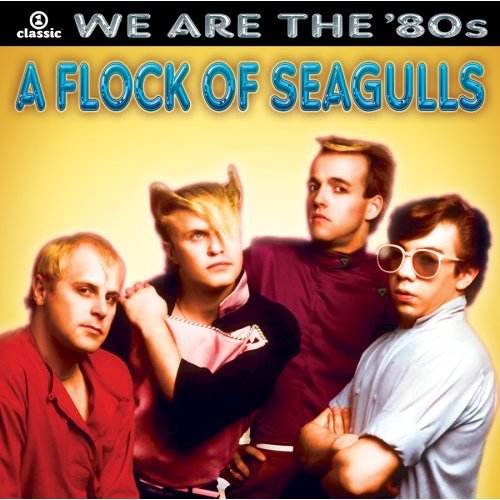
Well, you be the judge. Here come A Flock of Seagulls:


All right people -- here's your Guilty Pleasuresly Logical Lesson! The next time you're on the beach and you see the lead of A Flock of Seagulls, don't take any of his advice except for this: Run!


You know what I think was the meanest thing they did to this guy?


No, tell me Dad.


They had him in a hall of mirrors and that meant he got to see multiple images of himself. That's flat cruel, if you ask me.


Oh my goodness! That is cruel! So you're right, the 80s are creepy. But can they get more creepy?


Sure they can, Maria. Just watch this -- it's our old pal Lene Lovich:


Lucky number? Dad, if I have a lucky number I'd play it on the Powerball. This lady is Powerbad! Oh looky, here's her report card. Bad Hair: A+. Screaming like a kindergartner: A+. Creepy eyeball thing: A+. Being close to reality: F. That was just plain weird, Dad. And that's saying something, considering I live in the same house with Benster!


Oh, he's not that weird. He could be even weirder, like these guys, the almost forgotten Haysi Fantayzee:


Dad, how you could you have forgotten those guys? One's almost wearing no pants and the other guy looks like a clown that got run over and if I were singing the song, it would go like this: "Shiny Shiny, don't shake your behiney, sha la la, sha la la la - HUSH!" But I do like the end of the video, where the clown guy is slashing away his own failure to be entertaining!


Yeah, they do look like some sort of weird gypsy Goth version of the Ting Tings. Or maybe we could combine Lene Lovich and the Ting Tings and get this.


Dad, don't go there. Please. I'll get down on my knees and beg you if I have to. But I won't beg anyone to vote for their favorite song. You should be doing that already! You know that students, don't you? You know that every child of Guilty Pleasures High School must always vote for a winner in the comments section. If you don't vote, you're a loser! Well, maybe not a loser, but certainly lame! Anything else to add, Dad?


No, that seems sufficiently stern.


Housekeeping

Based on recent activity, I've decided to make a reluctant change to my comment policy. I am no longer going to allow anonymous comments on this blog. Let me explain what this means:

  • If you wish to comment, you do not have to provide your name. You will have the option of using Open ID and you can establish a screen name without having to register with this blog, or with Google or any other provider. You can remain anonymous in practice, but you can no longer be anonymous as a screen name. I am not requiring that you provide me with an e-mail address or other method to verify your identity.
  • My primary reason for this change is this: I have had the experience in recent weeks of having up to 3 different people make comments on the blog and all be labeled as "anonymous." I know they are different people, but I can't keep them straight.
  • Having said that, I am concerned about anonymous commenting generally. I have in the past moderated comments, but decided to remove that restriction some time ago. For the most part, comments on this blog have been reasonably civil and I've never had to drop a ban hammer on anyone. About the only comments that get nuked around here are spam. Having said that, as the readership and reach of this blog increases, the potential for problems increases. It is possible that I will reinstitute comment moderation in the future, but for now I'd prefer not to.
  • There are nearly 2000 posts on this blog and we are 4 1/2 years into this enterprise. It's becoming increasingly complicated to monitor everything that happens here, especially since I now have co-bloggers on the site. I'm hopeful that this change will help without causing anyone too much pain.
Thank you for your support of this feature.

Murphy's Law

An anonymous commenter brings word of today's latest dispatch from the New York Times involving the latest iteration of the scandals involving pedophile priests, especially the case of Lawrence Murphy, the horrible man who abused and violated as many as 200 young children during his tenure at St. John's School for the Deaf in Milwaukee. You can read the piece here.

Our anonymous commenter, who appears to be based in New York, is quite satisfied that Pope Benedict needs to be run out of town or something:

Looks like you have been misled by Brundage, not the Times. Face the facts. The Vatican made the decision NOT to proceed with a canonical trial, in spite of the fact that Murphy had admittedly raped children in confessionals while performing the sacrament of reconciliation, which is about as grave a canonical transgression as can be imagined. Why anyone would want to carry water for these lying thugs is beyond me. Ratzinger is up to his eyeballs in this and deserves whatever he gets. He had more compassion for an aging paedophile than he ever did for the 200 deaf children who were Murphy's victims and who never got justice, even from the Church. Oh the web we weave...
That's a pretty categorical statement and I'm not sure it holds up to scrutiny. We'll need to take a longer look at the matter and I'll do that later, hopefully this evening. One thing to think about in the interim: based on what we know, Murphy's crimes began as early as 1950 and continued until he left St. John's in 1974. At some point we need to account for the actions of those who were in a position to do something about it, both within the Milwaukee Archdiocese and the City of Milwaukee, during that nearly 25 year period, and in the 20 years following Murphy's departure from St. John's. Blaming Cardinal Ratzinger may fulfill some emotional need for justice, but I'm not convinced that it is justice. More soon.

Andy notices something


Congresswoman Bachmann might have to play things down the middle in the governor's race, but her husband certainly isn't similarly constrained. Note the second sticker that Marcus Bachmann is sporting over his sporty argyle sweater vest. The original is at Andy's blog, Residual Forces. At least a thousand words in this picture.

Wednesday, March 31, 2010

The Matter of Murphy

Let's say this straight out -- no Catholic is happy about the horrors that certain members of the priesthood visited upon innocent children over the course of the last 60 years. That we continue to find victims saddens all of us. Every Catholic that I know hopes that the victims can find some form of recompense for what happened.

Having said that, as a Catholic I believe it is long past time to stop accepting the dictates of fools and charlatans about our Church and, by extension, our faith. The matter of Lawrence Murphy, the priest who abused potentially hundreds of innocent children at the St. John's School for the Deaf in Milwaukee, has been only the latest brickbat by which the Catholics have been beaten over the last 20 years. A few thoughts:


  • I don't think any Catholic, or any Christian of any denomination, needs to pay much attention to the harangues of a cynical atheist like Christopher Hitchens.
  • Likewise, I don't much care what the cynical, blowsy Maureen Dowd has to say, either. She may claim to be nominally Catholic, but there is nothing in her background or her writings that suggests she understands the first thing about the Church.
  • The glee that the MSM has demonstrated in invoking the Watergate narrative in this matter ("What did the Pope know, and when did he know it") is either silly or offensive. I'm having a difficult time deciding which. The latest "revelation" I've read moves the scandal all the way back to Paul VI. I supect a letter directed to one of the Avignon Popes will surface in the coming days.
  • The key to understanding what happens is one word: anachronism. We are imposing the value judgments of today on events that happened years ago. The belief that was prevalent at the time was that pedophile priests could be treated and cured. As it turns out, that is not the case. It took too long for the Church to understand that, but we understand many things now that we didn't in, say, 1963.
  • Is there evidence that Pope Benedict was derelict in his duties? Not especially. We now have the testimony of William Levada, formerly the Archbishop of San Francisco, who now heads the Congregation for the Doctrine of the Faith, the office held by Benedict when he was known as Joseph Cardinal Ratzinger. Levada goes into great detail in discussing recent events and the news coverage. It's a longish piece but it's well worth your time to read it in full. The most relevant paragraphs are these:

Goodstein’s account bounces back and forth as if there were not some 20 plus years intervening between reports in the 1960 and 70’s to the Archdiocese of Milwaukee and local police, and Archbishop Weakland’s appeal for help to the Vatican in 1996. Why? Because the point of the article is not about failures on the part of church and civil authorities to act properly at the time. I, for one, looking back at this report agree that Fr. Murphy deserved to be dismissed from the clerical state for his egregious criminal behavior, which would normally have resulted from a canonical trial.

The point of Goodstein’s article, however, is to attribute the failure to accomplish this dismissal to Pope Benedict, instead of to diocesan decisions at the time. She uses the technique of repeating the many escalating charges and accusations from various sources (not least from her own newspaper), and tries to use these “newly unearthed files” as the basis for accusing the pope of leniency and inaction in this case and presumably in others.

I grew up in Wisconsin, in the Green Bay Diocese. Rembert Weakland, the Archbishop of Milwaukee, was always a controversial figure in the Church and his role in what happened in Milwaukee has not received a lot of attention. Weakland himself was forced from the Church in 2002, following revelations that he was an active homosexual who had long-standing affairs during his time as Archbishop. Weakland had both the motive and the standing to take action against Lawrence Murphy, but he did not. Is there a reason? No one knows, because it doesn't appear that he has been asked.

Weakland's successor, Jerome Listecki, says the blame belongs in Milwaukee:

Mistakes were made in the Lawrence Murphy case. The mistakes were not made in Rome in 1996, 1997 and 1998. The mistakes were made here, in the Archdiocese of Milwaukee, in the 1970s, the 1980s and the 1990s, by the Church, by civil authorities, by Church officials, and by bishops. And for that, I beg your forgiveness in the name of the Church and in the name of this Archdiocese of Milwaukee.

Listecki is correct. Yes, the Church has had a global problem and only in the last decade or so has it started to find a solution. It is important to understand that individual Archbishops have great authority and their own views matter a lot. If you doubt the importance of an individual archbishop, consider the ongoing attacks that John Nienstedt, who is the Archbishop here in the Twin Cities, faces from the likes of Nick Coleman. Weakland wielded enormous power in the Archdiocese, and by extension throughout heavily Catholic Wisconsin. And for reasons we do not know, he did not stop what happened at the St. John's School for the Deaf.

But you know what? In the end, the issue isn't really affixing blame for what happened. The larger issue is healing those who were hurt and ensuring that future generations of children will never face what the children at St. John's did. The Church continues to make progress on both fronts. We have a long way to go and it will take the prayers of the faithful. As a Catholic, I have a responsiblity to offer prayer and support for the victims. I do not have any obligation to accept the dictates of Maureen Dowd or her partners at the New York Times.

Credit Where Due -- Update

UPDATE (4/1/10): My esteemed colleague W. B. Picklesworth has convinced me that half the premise of this post is faulty. The President's announcement on oil exploration turns out to be a bit of a crap souffle on closer examination. Apologies to all for being a rube on this one -- Mr. D

We certainly bash the President around here rather a lot, primarily because much of what he does deserves bashing. But fairness requires that we praise the President when he does the right thing. And today, he did the right thing twice.

First of all, he has cleared the way for offshore oil and gas drilling in the Atlantic Ocean off the coast of Virginia. Later on, we learned that the U.S. test-fired a Trident missile in military exercises with Saudi Arabia, which was a clear message to Iran that clowntime is over.

Two good moves -- the environmentalists on Obama's side will go as ballistic as the missile that was fired, but too bad. There's no good reason to leave oil or natural gas in the ground. Meanwhile, the whackjob Iranian government gets a welcome reminder that while they might have designs on blasting Israel or immolating some Sunnis, there would be a fearsome price to pay. It's a clear message that should have been delivered a long time ago, but at least the message is clear. We take what we can get these days. Good show, Mr. President.

Home Truth

Greg Gutfeld gets to the heart of the matter:

Look, this debate is basic: it's small government vs. big government. So how cowardly do folks like Blood and Frank Rich have to be that they can't man up and defend their love for collectivism? The only reason they scream race, is because that debate scares them. They know a racial accusation prevents dialogue, because such a harmful charge far outweighs any benefits of winning an argument.

Read the whole thing -- won't take you long.

Tuesday, March 30, 2010

Radio Free Dilettante — Month-End Clearance Edition

And if there's ever been a month worth clearing out, it's this one:


Last Five:
Whipping Post, The Allman Brothers
Rudie Can’t Fail, The Clash
Touch Me I'm Going to Scream, Part 1, My Morning Jacket
Bang and Blame, R.E.M.
God Only Knows, The Beach Boys


Next Five:
Guajira, Santana
Strange Meadowlark, Dave Brubeck
Brand New Day, Van Morrison
The Ice of Boston, Dismemberment Plan
There's No Home for You Here, The White Stripes

I don't know if it makes any difference, but. . .

. . . given the absolute glee in the media over the latest pedophile scandal, especially the "what did the Pope know and when did he know it" meme, it might behoove a curious reader to get the actual view of one of the most important participants in unraveling the Lawrence Murphy scandal in Milwaukee. The always excellent Rocco Palmo at Whispers in the Loggia has excerpted a long piece from Fr. Thomas Brundage, who was judicial vicar in the Milwaukee Archdiocese and was responsible for overseeing the Murphy case. A small taste:

With regard to the inaccurate reporting on behalf of the New York Times, the Associated Press, and those that utilized these resources, first of all, I was never contacted by any of these news agencies but they felt free to quote me. Almost all of my quotes are from a document that can be found online with the correspondence between the Holy See and the Archdiocese of Milwaukee. In an October 31, 1997 handwritten document, I am quoted as saying ‘odds are that this situation may very well be the most horrendous, number wise, and especially because these are physically challenged , vulnerable people. “ Also quoted is this: “Children were approached within the confessional where the question of circumcision began the solicitation.”

The problem with these statements attributed to me is that they were handwritten. The documents were not written by me and do not resemble my handwriting. The syntax is similar to what I might have said but I have no idea who wrote these statements, yet I am credited as stating them. As a college freshman at the Marquette University School of Journalism, we were told to check, recheck, and triple check our quotes if necessary. I was never contacted by anyone on this document, written by an unknown source to me. Discerning truth takes time and it is apparent that the New York Times, the Associated Press and others did not take the time to get the facts correct.
There is no question that Lawrence Murphy was an evil man. There is also no question that the Church enabled his predations for a period of nearly 25 years, in ways small and large. The Church has much to explain and the explanations must continue. Most of all, I don't begrudge the victims seeking redress for the sins of Lawrence Murphy.

Yet this must be said as well: it also troubles me when leading news organizations don't bother to fact check the information they publish. I would strongly recommend that you click the link I've provided and read the statement of Fr. Brundage.

Every Picture Tells a Story, Don't It?


From the Tea Party rally at Searchlight, Nevada, a provocative image. Lots more at the link.

Every Picture Tells a Story, Don't It, Part Deux


From an "anti-war" rally in Los Angeles, one week prior to the Searchlight event. Charming.

News You Could Have Used

In the Washington Post, Robert J. Samuelson locks the barn door after the horses are gone:

When historians recount the momentous events of recent weeks, they will note a curious coincidence. On March 15, Moody's Investors Service -- the bond rating agency -- published a paper warning that the exploding U.S. government debt could cause a downgrade of Treasury bonds. Just six days later, the House of Representatives passed President Obama's health-care legislation costing $900 billion or so over a decade and worsening an already-bleak budget outlook.

Should the United States someday suffer a budget crisis, it will be hard not to conclude that Obama and his allies sowed the seeds, because they ignored conspicuous warnings. A further irony will not escape historians. For two years, Obama and members of Congress have angrily blamed the shortsightedness and selfishness of bankers and rating agencies for causing the recent financial crisis. The president and his supporters, historians will note, were equally shortsighted and self-centered -- though their quest was for political glory, not financial gain.

Well, yeah. Historians will also note that the publication date of this piece was March 29, 2010, not March 16, 2010, when it might have helped. Despite that, you should read the whole thing. I especially commend it to the attention of my lefty friends, as many talking points are demolished here.

Monday, March 29, 2010

What about the Hutaree?

1) Give them Kathleen Soliah's old cell; or
2) Send 'em to Gitmo

Pay Attention Redux

You might remember last week that I brought up the bond markets and suggested that it's time to start paying attention to what's happening. It turns out some people are paying attention:

Former Federal Reserve Chairman Alan Greenspan said the recent rise in Treasury yields represents a “canary in the mine” that may signal further gains in interest rates.

Higher yields reflect investor concerns over “this huge overhang of federal debt which we have never seen before,” Greenspan said in an interview today on Bloomberg Television’s “Political Capital With Al Hunt.”

“I’m very much concerned about the fiscal situation,” said Greenspan, 84, who headed the central bank from 1987 to 2006. An increase in long-term interest rates “will make the housing recovery very difficult to implement and put a dampening on capital investment as well.”

And then there's this:

The first warning was in mid February, the bad news was that led by China, foreign countries dumped U.S. Treasury bills at a record rate in December. The worry was that the weak marketplace lead to a rise in interest rates to make the bills more attractive to investors. The interest rate rise which could be the beginning of an inflationary period. According to the Treasury Department foreign holdings of U.S. Treasury bills fell by a record $53 billion in December. That topped the previous record drop of $44.5 billion in April 2009.

If we're going to continue spending like crazy, we need someone to finance our debt. If foreign investors aren't going to do it, we have issues. The message is increasingly clear to those who are willing to listen: the party is pretty much over.

Unfortunately, the Obama administration and its friends on Capitol Hill aren't listening:

The trigger for last week's sell-off was poor demand at Treasury auctions, linked to the passage of the Obama health care reform. Critics say it will add $1 trillion (£670bn) to America's debt over the next decade, a claim disputed fiercely by Democrats.

And they've got the gamed CBO report to prove it! But there's even more:
Looming over everything is the worry that markets will not be able to absorb the glut of US debt as the Fed winds down its policy of bond purchases, starting with an exit from mortgage-backed securities. It currently holds a quarter of the $5 trillion of the MBS market.

The rise in US bond yields has set off mayhem in the 10-year US swaps markets. Spreads turned negative last week, touching the lowest level in 20 years. The effect was to drive credit costs for high-grade companies such as Berkshire Hathaway below that of the US government. This may have been a technical aberration.

I sure hope it's a "technical aberration." But it seems like more of a feature than a bug.

Sunday, March 28, 2010

Henry is Not Happy


AT&T Inc. will take a $1 billion non-cash accounting charge in the first quarter because of the health care overhaul and may cut benefits it offers to current and retired workers.

The charge is the largest disclosed so far. Earlier this week, AK Steel Corp., Caterpillar Inc., Deere & Co. and Valero Energy announced similar accounting charges, saying the health care law that President Barack Obama signed Tuesday will raise their expenses. On Friday, 3M Co. said it will also take a charge of $85 million to $90 million.

Oops. That wasn't supposed to happen. And now Congress is getting involved. . . by attempting to intimidate the companies for mentioning it. Powerline reprints a letter that the odious Henry Waxman (and his new best pal, Bart Stupak) sent to AT&T after it had made the announcement -- page one is here, page two is here. Waxman is very good at running star chambers and his goal is to cow the corporate execs into disavowing such statements, lest they contradict the promises that Waxman, Obama, Pelosi, Stupak and the rest of our protectors have made regarding this legislation.


There's a problem with all that, though -- the reason that AT&T has to disclose such things is because of another federal rule, Sabanes-Oxley. Section 409 requires the following:


Issuers are required to disclose to the public, on an urgent basis, information on material changes in their financial condition or operations. These disclosures are to be presented in terms that are easy to understand supported by trend and qualitative information of graphic presentations as appropriate.

Of course, if you follow the law and disclose things that Henry Waxman doesn't like, you'll be dragged in front of his committee to explain yourself.


In most cases, the truth is an absolute defense. That may no longer be true. As if you needed any other reason to vote out the Democrats in November, I can think of few better reasons than taking the gavel out of Henry Waxman's hand.

Saturday, March 27, 2010

If you read nothing else today. . .

. . . make sure you read this outstanding essay from Doctor Zero. There's so much good stuff here that it's hard to pick just one excerpt, but try this:

There’s no reason a country with vast natural resources, tended by a bold and innovative people, should suffer double-digit unemployment and capital flight. A compassionate nation, whose daily industry has done more for the downtrodden than every utopian scheme combined, has no reason to lower its head in shame, and tolerate the extraction of “charity” at gunpoint. The veterans of bloody wars against lawless tyranny should not accept a system that makes fools of the industrious. A great people, who live in reverence of equality, require no lists of class and racial enemies from opportunistic politicians.

There's a lot more at the link. Click it, capisce?

Friday, March 26, 2010

The Poop Bank

As many of you know, I write catalog and web copy for a decent-sized privately held company. Sometimes in the course of my duties I am asked to write catalog copy for gag gifts. One of the products I wrote for an upcoming catalog is the "Poop Bank," which is a coin bank that is shaped like a pile of, well, poop. Rest assured, my presentation of this item was tastefully rendered and you'll be able to see it for yourself when the catalog comes out in the fall. (By the way, the link is to our vendor).

As it turned out, I wasn't the only person writing about poop banks this week. A couple of reporters for the Washington Post were describing a steaming pile as well:


The Obama administration plans to overhaul how it is tackling the foreclosure crisis, in part by requiring lenders to temporarily slash or eliminate monthly mortgage payments for many borrowers who are unemployed, senior officials said Thursday.

Banks and other lenders would have to reduce the payments to no more than 31 percent of a borrower's income, which would typically be the amount of unemployment insurance, for three to six months. In some cases, administration officials said, a lender could allow a borrower to skip payments altogether.
This is madness, of course. Let us count just some of the ways:
  • Perhaps I'm simply being provincial here and haven't gotten wise to the new realities, but there was a time, really not that long ago, when the government viewed one of its duties to be helping to enforce legal contracts, rather than abrogating them.
  • Once again, let's go back to one of the most important issues in any economic system: moral hazard, which can be defined as follows: the risk that the presence of a contract will affect on the behavior of one or more parties. The classic example is in the insurance industry, where coverage against a loss might increase the risk-taking behavior of the insured.
  • When the federal government inserts itself into a mortgage contract and changes the terms, it is inviting moral hazard up the wazoo. Let's be honest here: why should anyone be prudent and buy less home, or save for a rainy day, when the government is willing to rewrite a mortgage to your benefit if you are laid off? Why not just live large instead? Uncle Sam will hook you up.
  • If you were a prudent banker, and yes there are still a few of them extant, how would this ruling affect your bank's underwriting and decisionmaking process? Would you even want to make a loan to anyone who isn't gold-plated and as risk-averse as a prudent banker would be?
  • And where is the money coming from? Do we simply expect the banks to eat the costs? Or will they be made whole somehow? What are the chances we'll have the money, now or in the future?

The Post article claims the money is there to make the banks whole:

Officials said the new initiatives will take effect over the next six months and be funded out of $50 billion previously allocated for foreclosure relief in the emergency bailout program for the financial system. No new taxpayer funds will be needed, the officials said.

Do you believe that? Everyone knows that while the money may have been previously allocated, it's simply money that the government borrowed from someplace else.

Let's do the math here: according to this document (note: it's a PDF) from the Bureau of Labor Statistics, there are somewhere in the neighborhood of 14.9 million people who are currently unemployed in the United States. According to this piece on MSN, the average weekly unemployment benefit in the United States is $293. At 4 weeks per month, that works out to $1172.

If the limit on a mortgage payment is 31% of that, it would mean that, on average, the maximum mortgage payment an unemployed person would make is $363.32. At the height of the housing bubble in 2006, the average monthly mortgage payment was $1,687. If we assume that in 2010, housing values have dropped by, say, 25%, we could assume that the average mortgage payment is also about 25% less, which would be about $1,265. That means that the banks would have, on average, about a $902 shortfall per month. Presumably the government would make the banks whole for this shortfall.

If the benefit lasted for six months, that would mean each taxpayer affected would receive a benefit of about $5,412. Let's assume that 60% of the unemployed are homeowners with mortgages -- that would mean about 8.9 million homeowners would receive a benefit of $5,412. How much money is that? $48.4 billion, just shy of the $50 billion that is available.

But riddle me this: does anyone assume that the benefit would go away after 6 months? Or would it continue? I think we know the answer to this one. And does anyone think that unemployment is going to abate any time soon? Not even the Obama administration believes that.

We are broke now. The government thinks it can afford to do things like this program, but it can't. And the government can't assume that foreign investors are going to continue to pay for our profligacy, because it's simply not true.

Then again, if the government has no trouble abrogating existing contracts, perhaps they won't hesitate to abrogate the arrangements they have made with its lenders, right? There are other people who worry about these things, too, and their views matter a lot more than mine do.

We have some serious issues, folks. And the people who are currently running the federal government don't appear to be thinking through the implications of the commitments they are making.

Lightning Round - 032610

Gotta go fast:

  • If this report in the Times of London is true, and I really hope it isn't, it says something truly awful about the Leader of the Free World. Actually, many things.
  • I've been trying to watch the NCAA men's basketball tournament in between everything else that's been going on and it's been great theater, as usual. Last night's game between Kansas State and Xavier, which K-State won in double overtime 101-96, was some kind of classic. My bracket is destroyed (heartfelt thanks to the University of Northern Iowa) but it's been a hoot. The Benster could win our office pool if his team (West Virginia) pulls it off, so go Mountaineers, I guess.
  • If you've suspected that the evil right-wing kook violence against members of Congress meme is overplayed, we now have conclusive evidence that it has jumped the shark entirely.

Thursday, March 25, 2010

Brain space


Enough of the damned politics.


Fearless Maria and I weren't able to get our act together to write a Guilty Pleasures tonight, so I thought I'd try something different. I'm going to offer you two video links from the late 1970s. These are two songs that I personally like a lot. Tell me if you think these songs work together well, because I think they do.


The first was probably the biggest hit for the Los Angeles funksters the Brothers Johnson, from 1977:


About a year later, we heard from the British band 10cc, who were a pretty spotty outfit overall but had a habit of hitting their singles on the nose:


These are two different songs but they have always shared space in my brain because they are both soft-spoken, minor key songs with a medium tempo with a somewhat dream-like quality, I guess. I think that's it, at least.


So here are my questions for you:


1) Do you hear the same thing I hear?

2) Are there any two similar songs that share space in your brain the way these two songs share space in my brain?

The Ghost of Christmas Past

In all the hoopla/wailing and gnashing of teeth over ObamaCare, it would have been easy to miss this news -- Social Security is now paying out more than it is taking in:

This year, the system will pay out more in benefits than it receives in payroll taxes, an important threshold it was not expected to cross until at least 2016, according to the Congressional Budget Office.

Stephen C. Goss, chief actuary of the Social Security Administration, said that while the Congressional projection would probably be borne out, the change would have no effect on benefits in 2010 and retirees would keep receiving their checks as usual.

The problem, he said, is that payments have risen more than expected during the downturn, because jobs disappeared and people applied for benefits sooner than they had planned. At the same time, the program’s revenue has fallen sharply, because there are fewer paychecks to tax.

Analysts have long tried to predict the year when Social Security would pay out more than it took in because they view it as a tipping point — the first step of a long, slow march to insolvency, unless Congress strengthens the program’s finances.
We've known that this moment was going to come and we've known it for rather a long time. The demographic problem in this nation has been evident for at least 25 years, when it became clear that the Baby Boomers were not going to have enough children to keep paying the freight. We've continued to kick the can down the road; while George W. Bush made an effort to reform Social Security in 2005, he got shot down pretty fast, mostly by the people who are now at the helm. Consider the words of Nancy Pelosi, in her 2005 "prebuttal" to President Bush's State of the Union address:

The President talks about a crisis, but according to the nonpartisan Congressional Budget Office, Social Security will be solvent for nearly 50 years.

This was a common thread back then. I remember well having discussions/arguments with one of my liberal co-workers about this. He insisted that Social Security was doing just fine and that there was nothing to worry about -- he tended to take Talking Points Memo literally in those days -- every argument that Joshua Micah Marshall made in TPM back then hurtled through the cubicles of our Bloomington offices. My co-worker, TPM and Mrs. Pelosi won the day and Bush retreated from his plans.

Now we are 5 years on and the day of reckoning is beginning to approach. We have this week added another entitlement with costs that will explode into the trillions. We pile this on the costs imposed through Bush's greatest mistake, Medicare Part D, Medicare itself and the grossly underfunded public pension system.

It is my assumption that the Baby Boomers won't willingly sign up to be Soylent Green; if they follow their normal pattern, they will be clawing for every penny that was ever promised to them. I'm part of that demographic (born 1963), but most people my age don't assume that we will see much from Social Security; we've watched our generational big brothers and sisters long enough to see that they'll take what they can get and won't worry much about the rest of us.

Like me, Barack Obama is part of the late Boomer set (born 1961, in Hawaii I might add). He's seen the same things I've seen and has decided to kick the Social Security can down the road, too, as well as throwing his new load on our shoulders. I honestly wonder how we're going to pay for all this largesse. More importantly, who is going to pay for it? Somehow, I don't think Benster or Fearless Maria will be too keen about ponying up half their income to support my generation in our dotage.

Metrics

Megan McArdle makes an important point:

Americans were not told that American households would be 1% less worried about bankruptcy, or that we'd save a hundred thousand lives over thirty years.
They were regaled with eye-popping statistics on deaths from lack of health insurance--I certainly was, by many of the very same commenters who are now suddenly wary of prediction making. If you quoted those statistics, you were committing to a pretty strong position on the benefits of this bill. By my count, since we're now supposed to be covering at least 2/3 of those who are currently uninsured, and the remainder are often immigrants who trend younger than the general population, you believe that we should see a reduction of at least 15,000 deaths a year. You might argue me down to 12,000, but you couldn't get me as low as ten. That is what is implied by citing a figure of 20,000 deaths a year.

If you quoted Himmelstein et al's 45,000, obviously you should be expecting deaths to fall by at least 25,000 a year, very conservatively. If we don't see such improvements, then those studies were wrong. And if you won't commit to saying that you expect such a sizable reduction in our mortality rate, then you were wrong to cite them.

We are committing a huge amount of the public fisc to this bill. We'd better see the benefits. Read the whole thing.

Wednesday, March 24, 2010

Pay Attention

The auction of 5-year treasury bills didn't go so well today. Pay attention everyone: the market is trying to tell you something:

At today’s auction, investors bid for 2.55 times the amount on offer, the lowest since September’s sale. Indirect bidders, a class of investors that includes foreign central banks, purchased 39.7 percent of the notes, the lowest since July.

The auction drew a yield of 2.605 percent, compared with the average forecast of 2.556 percent in a survey of eight of the Federal Reserve’s primary dealers. The gap of 4.9 basis points was the largest since a 5.4 basis point spread in July, according to Bloomberg surveys.

The decline in indirect bids comes as U.S. lawmakers have resumed efforts to force China to allow the value of its currency, the yuan, to appreciate. Senator Charles Schumer, a New York Democrat, said yesterday he will seek to pass legislation before the end of May that would push China to raise the value of its currency.

“I would not be surprised if the low indirect bid had something to do with the Chinese sitting on their hands,” said Joseph Brusuelas, a strategist at Brusuelas Analytics in Stamford.

So what kind of legislation can Chuck Schumer push that would cause the yuan to appreciate? And why are the Chinese "sitting on their hands?"

The Quality Goes In Before the Name Goes On

Real politicians of genius:

Hours after President Barack Obama signed historic health care legislation, a potential problem emerged. Administration officials are now scrambling to fix a gap in highly touted benefits for children.

Obama made better coverage for children a centerpiece of his health care remake, but it turns out the letter of the law provided a less-than-complete guarantee that kids with health problems would not be shut out of coverage.

Under the new law, insurance companies still would be able to refuse new coverage to children because of a pre-existing medical problem, said Karen Lightfoot, spokeswoman for the House Energy and Commerce Committee, one of the main congressional panels that wrote the bill Obama signed into law Tuesday.
Bummer, dude. But there's a fix in the works, right?

Full protection for children would not come until 2014, said Kate Cyrul, a spokeswoman for the Senate Health, Education, Labor and Pensions Committee, another panel that authored the legislation. That's the same year when insurance companies could no longer deny coverage to any person on account of health problems.
All the urgency to pass this crap sandwich and no bennies until 2014? Where's our Big Rock Candy Mountain?

Fortunately, I was able to find the relevant language at this link:

Step right up

Please allow thirty days for delivery, don't be fooled by cheap imitations

You can live in it, live in it, laugh in it, love in it


Swim in it, sleep in it,


Live in it, swim in it, laugh in it, love in it


Removes embarrassing stains from contour sheets, that's right


And it entertains visiting relatives, it turns a sandwich into a banquet


Tired of being the life of the party?


Change your shorts, change your life, change your life


Change into a nine-year-old Hindu boy, get rid of your wife


And as always, remember what Mr. Waits says:

You got it buddy: the large print giveth, and the small print taketh away

Holy Boland Amendment, Batman!

It's a longstanding Washington tradition -- using the legislative process to score cheap points and complicate the lives of your opponents. We're going to see a lot of it in the coming days.

First, a little history. If you were around in the 1980s, you might remember something called the "Boland Amendment." The Boland Amendment was the handiwork of a backbencher Massachusetts congressman named Edward Boland. During the Reagan years, Boland would routinely attach an amendment to the last-second omnibus spending bills that Congress would pass to keep the government running. The amendment would bar the Reagan administration from aiding the efforts of the Nicaraguan contras against the Marxist Sandinista government. This was ridiculous, of course -- it wasn't the purview of a backbencher congressman to dictate foreign policy, but Reagan was forced to either sign the budget bill with the Boland Amendment or issue a veto and shut the government down. And it was precisely because of the Boland Amendment, which was treated as a Holy of Holies by the Democrats and their media pets, that we had the Iran-contra "scandal."

Now that ObamaCare is law in the form of the Senate bill that is much hated for the corrupt dealings that were involved in its passage, Congress is acting to take up a reconciliation bill that would supposedly fix things like the Cornhusker Kickback, the Louisiana Purchase and other such goodies that grabbing Senators received for their votes. And this gives the Republicans a chance to embarrass the Democrats. We have two pretty good examples already.

First, the amusing one:

On Tuesday, the GOP put its strategy into action, with Sen. Tom Coburn (R-Okl.) introducing an amendment beyond agreeable. Titled “No Erectile Dysfunction Drugs To Sex Offenders” it would literally prohibit convicted child molesters, rapists, and sex offenders from getting erectile dysfunction medication from their health care providers.

While it will undoubtedly be difficult for Democrats to vote against the measure (one can conjure up the campaign ads already), the party plans to do just that.

“Democrats in the Senate are very unified that this is not going back to the House,” Sen. Wyden (D-Ore.) told the Huffington Post on Tuesday, minutes before the Coburn amendment was introduced.

Allahpundit makes an appropriately mordant observation:

Everyone get the joke here? If the Dems amend the reconciliation bill for any reason, they have to send it back to the House for yet another vote. So anything the GOP proposes — anything — they’re basically bound to vote no on. And Coburn knows it. One tasty shinola sandwich, coming up! Although I’m confused: If, as the left has convinced itself, ObamaCare is pure win for them politically (see, e.g., today’s ridiculously overhyped Gallup poll), what’s the aversion to another House vote? In fact, why not ping-pong the bill back and forth between the chambers for another month, loading it up with ever more crowd-pleasing amendments? It’s time to own the glorious political victory that looms in November, liberals.

Then there's this:

As the Senate grinds through 20 hours of debate on the health care reconciliation bill, Sen. Charles Grassley, R-Iowa, Tuesday night offered an amendment that would require the president, vice-president, members of Congress, political appointees and congressional staff to get their federal health benefits through the soon-to-be-created health insurance exchanges.

This group currently gets insurance through a system overseen by the Office of Management and Budget and under the health care bill signed into law today, some of the congressional staff would have to sign up for insurance through the exchanges. But some would be exempted. Politico filed a story Tuesday night pointing out that leadership and committee staff are exempt from having to use the exchanges. This has caused a bit of an uproar on Capitol Hill, with Republicans accusing top Democratic staff of writing a health care law that's not good enough for them to participate in.

"President Obama has publicly advertised that his reforms would give members of the public the same coverage available to Members of Congress," reads a GOP summary of the Grassley measure. "This amendment would ensure that he, his
successors, and all his appointed political officials would also have the same coverage members of the public enrolled in the Exchange receive."
Your assignment: tell me why such an amendment is a bad idea.

Tuesday, March 23, 2010

What's next from our overlords?

How about a VAT? Michael Barone explains:

On Sunday, 219 House Democrats, soothed by their leaders' gaming of the CBO scoring process, voted in reckless disregard of what the bond market has been telling them. Some may share Speaker Nancy Pelosi's optimism that the government's looming fiscal disaster can be avoided by imposing a value added tax -- in effect, a national sales tax.

Gee, there's a great idea. And the drums are already beating from the op-ed hamsters. The always-reliable David Brooks thinks it's inevitable:

The task ahead is to save this country from stagnation and fiscal ruin. We know what it will take. We will have to raise a consumption tax. We will have to preserve benefits for the poor and cut them for the middle and upper classes. We will have to invest more in innovation and human capital.

The issue with a VAT is simple: it's a tax designed to be hidden from view. The end consumer pays the tax in a hidden way, as producers up and down the supply chain pass along their costs. Eventually everything you buy will cost 15-20% more than it would have ordinarily. And that is a best-case scenario, given the way the feds have been printing money. Ever since Paul Volcker and Ronald Reagan wrung the Carter-era monetary bungles out of the economy, inflation has been modest. We are currently recreating the economic conditions of the 1970s, with a vengeance.

Will this cunning plan work? Back to Barone:

But, as we know from the experience of high-tax Western Europe and relatively low-tax America over the last three decades, higher taxes tend to retard economic growth. Lower economic growth means less revenue for government than in CBO projections. Less revenue means more borrowing -- and at some point lenders are going to call a halt.

And already we're seeing the implications, as Moody's has already threatened to lower the credit rating for U.S. Treasuries:

If Moody’s were to downgrade the country’s rating, the impact could be severe. It would signal to lenders worldwide that the US is no longer one of the safest places to invest money.

That, in turn, would threaten the country’s ability to borrow freely and extensively from other countries on favorable terms. Investors would likely demand a higher interest rate to finance US debt, which would push federal debt higher still.

And remember, Moody's issued this warning last week, before the House passed ObamaCare. Not to put too fine a point on it, but as our Vice President said today in a different context, this is a big $@*! deal.

Let's be honest here -- the VAT is going to be a non-starter, and it should be. There's only one sure way to stop this madness and that is cut down on the spending. It's going to suck, but the current path Obama and the rest of his minions are charting will be a whole lot worse.

Another Home Truth

Jonah Goldberg gets to the heart of the matter:

The government has surged over the breakwater and is now going to flood the nooks and crannies of American life. Americans will now fight over what tax dollars should cover and not cover. Debates over "subsidizing" this "lifestyle" or that "personal choice" will erupt. And when conservatives complain, liberals will blame them for perpetuating the culture war.

Put simply, if your "lifestyle choice" is tied to the public fisc, it is subject to review. And when this bill is signed into law, we lose a significant chunk of our freedom. And the irony is this: a lot of people who supported this legislation routinely make lifestyle choices that are, shall we say, potentially bad for their health. Your eating habits, your sexual practices and your leisure activities will soon be matters of scrutiny. And there is no more dangerous moralist than a moralist with the power of the purse.

Monday, March 22, 2010

Something to watch

The Democrats are going to lose seats, potentially a lot of them, because of their perfidy in passing the bill last night. But you know what's going to be interesting? Here is the list of Democrats who voted no. I will be very curious to see how many of this group lose their seats, especially in comparison to the number of members who voted yes.

Whatcha think?

Sunday, March 21, 2010

The final tally

From the roll call.

Tim Walz? Ron Kind? Steve Kagen?

We comin' for you. Congratulations to all of you for signing your resignation letters.

Lessons of the day

It's pretty simple, really:

  • There is no such thing as a "pro-life" Democrat. In the end, Bart Stupak sold out every principle he has ever publicly espoused on this issue, for a promise from a man whose word is no good. Bart Stupak might be bunking with Doug Kmiec in Malta come January.
  • When you elect the Party of Government, don't be surprised if they try to extend their governing to every aspect of your life.
  • Because of the previous mistakes that the Party of Government has committed (Social Security, Medicare) and the complicating mistakes that the Stupid Party has made (extending the prescription drug benefit and committing us to trillions of unfunded liabilities), we are facing a financial catastrophe in the next 10-20 years. The Party of Government has decided to face that issue by doubling down.
  • Elections have consequences. Sometimes, very, very bad consequences.

But enough of that. Time to get to work. We have a Republic to save.

It was a bright cold day in March, and the clocks were striking thirteen

UPDATE (10:10 p.m., 3/21/10): make that 219 votes.

As the House of Representatives meets today to change our nation forever on a strictly partisan vote, remember that despite the best efforts of our betters, there will continue to be innovators who will develop work-arounds to the rotting edifices of government design. We have not reached the point we are in this world by dimly accepting the dictates of the busybodies and blackguards who will vote today to impose their misguided dream.

We will continue to learn, to adapt, to pioneer, to achieve and to overcome the obstacles that we place in our own path. We will do these things because we have abilities, drive and faith.

It's a beautiful early spring day in the Minneapolis-St. Paul area. We've done what we could to change the course of the events that will take place today in our nation's capital. I'm going to enjoy this day, secure in the knowledge that whether our representatives do the right thing today, we as Americans still will have the opportunity to put things right if they don't.

Be not afraid. God has blessed this nation and blessed us all. That doesn't change because 216 or 217 individuals vote otherwise.

Saturday, March 20, 2010

Gina Bauman Wins SD 50 Endorsement


At this time Minnesota Senate District 50 is DFL territory, but the team that is working to change that was finalized this afternoon at the SD 50 convention at Christ the King Lutheran Church in New Brighton.


The delegation overwhelmingly selected New Brighton City Council member Gina Bauman to face incumbent Sen. Satveer Chaudhary in the November election. Gina is now in her second term on the the City Council and has served with great distinction as a consistent voice for fiscal sanity. She was instrumental in keeping the city property tax levy at 0% for this year, a rare and positive change for the city. Gina has an extensive financial and budgeting background and also runs a coffee shop in New Brighton, Cuppachiodo's, which is well known and regarded in the area.


Gina has a strong campaign organization already in place and a significant group of supporters in New Brighton. She's extremely smart and quick on her feet, which proved to be a significant advantage during the endorsement process. She's also not afraid of a fight; she was instrumental in challenging the political barons who have run New Brighton for much of the last 20 years. She is well acquainted with the local issues within the district and her background provides her with the right skill set for the Senate, which is sorely lacking in fiscal discipline these days. She will be a formidable candidate.


Senate District 50 spans Anoka and Ramsey Counties and includes the cities of Columbia Heights, Fridley, New Brighton, Arden Hills and portions of St. Anthony and Shoreview. The incumbent, Satveer Chaudhary, has served two largely anonymous terms in the State Senate. He has been a loyal member of the DFL caucus, which may turn out to be a mixed blessing in this election cycle. Chaudhary might be best known for a political kerfuffle he went through in 2008, when it was revealed that he had advanced the interest of Arctic Cat, which was sponsoring an outdoor sports cable show Chaudhary hosted. It also turned out that Arctic Cat had given Chaudhary a discount on a snowmobile. Our friends at Boots On wrote about the case at the time.


Bauman joins the endorsed House candidates, Tim Utz (50A) and Russell Bertsch (50B), who are running against DFL incumbents Carolyn Laine and Kate Knuth. While it will not be easy to oust this trio of DFL incumbents, this is a strong group of Republican candidates. We'll continue to follow the races closely here.

Friday, March 19, 2010

Two more portraits in the Charmin Gallery

The scales continue to fall from the eyes.

You'll recall that Caterpillar once was the proud scene of an Obama photo opportunity early in his presidency, in which Obama promised that because of his manful work in passing the stimulus bill, Cat would be hiring soon. It hasn't happened, of course. So how is Obamacare playing in Peoria?

Caterpillar Inc. said the health-care overhaul legislation being considered by the U.S. House of Representatives would increase the company's health-care costs by more than $100 million in the first year alone.

In a letter Thursday to House Speaker Nancy Pelosi (D-Calif.) and House Republican Leader John Boehner of Ohio, Caterpillar urged lawmakers to vote against the plan "because of the substantial cost burdens it would place on our shareholders, employees and retirees."

Caterpillar, the world's largest construction machinery manufacturer by sales, said it's particularly opposed to provisions in the bill that would expand Medicare taxes and mandate insurance coverage. The legislation would require nearly all companies to provide health insurance for their employees or face large fines.

The Peoria-based company said these provisions would increase its insurance costs by at least 20 percent, or more than $100 million, just in the first year of the health-care overhaul program.

$100 million dollars is a lot of money. That may not seem to be the case to our friends in Washington, especially when you consider that our solons are spending that much money each time they blink, but Caterpillar doesn't have the luxury of turning on a printing press. What will Caterpillar do? It's hard to say, but if I were the average laid-off machinist in Peoria, I wouldn't be betting on getting a job with Cat any time soon. And if they do hire, I would imagine that at least some of the people will be offered work as independent contractors. The people who run Caterpillar are smart enough to understand that it doesn't do a lot of good to plan for the future when people who can affect your future are as mercurial as Team Obama.

Then there's the prodigal speechwriter, Peggy Noonan, who seems to have noticed something:

Excuse me, but it is embarrassing—really, embarrassing to our country—that the president of the United States has again put off a state visit to Australia and Indonesia because he's having trouble passing a piece of domestic legislation he's been promising for a year will be passed next week. What an air of chaos this signals to the world. And to do this to Australia of all countries, a nation that has always had America's back and been America's friend.

How bush league, how undisciplined, how kid's stuff.

You could see the startled looks on the faces of reporters as Press Secretary Robert Gibbs, who had the grace to look embarrassed, made the announcement on Thursday afternoon. The president "regrets the delay"—the trip is rescheduled for June—but "passage of the health insurance reform is of paramount importance." Indonesia must be glad to know it's not.

We've had a number of these sorts of epiphanies in recent days, especially among people like Noonan who were quite blithe in reassuring us that the man who now occupies the White House would do a good job and was the far superior choice. Those assurances now? How bush league, how undisciplined, how kid's stuff.

The prodigal is starting to see things clearly, though. Here is a sharp observation on the Wednesday interview that Obama conducted with Brett Baier of Fox News:

Thursday's decision followed the most revealing and important broadcast interview of Barack Obama ever. It revealed his primary weakness in speaking of health care, which is a tendency to dodge, obfuscate and mislead. He grows testy when challenged. It revealed what the president doesn't want revealed, which is that he doesn't want to reveal much about his plan. This furtiveness is not helpful in a time of high public anxiety.
You'd be furtive, too, especially if you were doing what Barack Obama is trying to do, which is to cram down perhaps the most fundamental policy change in the last 50 years with a completely partisan majority, in a time where public opinion is decidedly against such a sweeping change.

What to make of this? I'm somewhat torn. I was a fan of Peggy Noonan for a long time and her two-year infatuation with Obama has been highly frustrating, because she should have known better. She's less silly than the risible David Brooks, but she's a long way from emulating the late William Safire, the New York Times columnist and old Nixon hand who supported Clinton in 1992, came to regret it and said as much. Perhaps Noonan will be willing to step all the way back from where she's been.

Home Truth

The always brilliant Doctor Zero zeroes in:

The only guarantee you have that ObamaCare will provide the promised benefits, and remain within its boundaries, is the trust you place in the word of Barack Obama and his party… and your faith in future politicians who have yet to be elected.
Talk about a faith-based initiative. What's a more likely scenario?

It would be a horrible mistake to accept a deal with the creators of history’s most staggering natonal debt, based on assurances they will place your interests ahead of theirs, for decades to come. As Darth Vader memorably explained to Lando Calrissian, the State can always alter the terms of the deal, and your only recourse will be praying they don’t alter it any further.
Damn straight. Read the whole thing.

Thursday, March 18, 2010

Reasons to be cheerful

I'm trying to smile. Really, I am.

Given the way Congress and the president have chosen to shove the crap sandwich of "health care reform" down our throats, it's easy to be angry or bitter right now. But if we are to be effective, we must remain happy warriors. And it's always a good idea to stay cheerful.

An example -- while I was sad to see that Alex Chilton died, I'm cheerful because my brother Mike has rejoined the fray to post about Chilton and his work in the post immediately below. Chilton should have been one of the biggest names in music but he never got over, for a lot of reasons that were mostly outside of his own influence. He gave us a lot of wonderful songs and he continued to pursue both the audience and his own muse throughout his life and he made this world a better place because of it. That's worth celebrating, even as we mourn his loss.

There's another song by a long-gone rocker that I always remember when I start to get angry about things: Reasons to be Cheerful (Part 3), by Ian Dury and the Blockheads, from about 1979, in which the irrepressible Dury, who survived childhood polio and had a fair-to-middling career, relates things that make him cheerful, including the following random things:

Some of Buddy Holly, the working folly
Good Golly Miss Molly, and boats
Hammersmith Palais, the Bolshoi Ballet
Jump back in the alley add nanny goats

18-wheeler Scammels, Domineker camels
All other mammals plus equal votes
Seeing Picadilly, Fanny Smith and Willy
Being rather silly, and porridge oats
A bit of grin and bear it, a bit of come and share it
You're welcome we can spare it - yellow socks
To short to be haughty, too nutty to be naughty
Going on forty - no electric shocks

I can definitely agree with Buddy Holly and the references to Little Richard. As for nanny goats, and no electric shocks? Hey, whatever works.

We all have our reasons to be cheerful, whether we want to say them or not. But as we go through this low, mendacious period in our lives, we owe it to ourselves to remember those things that make us cheerful. There are plenty of things to hate in this world but spending too much time on hate diminishes us.